
Living with Climate Change
Photo : Raphaëlle Ainsley-Vincent
On the Lower North Shore, the impacts of climate change affect our daily lives in many ways: canceled trips, unpredictable seasons, and difficulties traveling within the territory.
To develop a regional overview of this situation, the MRC collaborated with the Canada Research Chair with Living Environments of the North at UQAM’s Department of Geography.
The research project Living Daily with Climate Change on the Lower North Shore Yesterday, Today and Tomorrow is the result of this partnership.
The resulting report and narrative map are presented here.
Research Report and Narrative Map
Living Daily with Climate Change on the Lower North Shore Yesterday, Today and Tomorrow. Produced by the Canada Research Chair With Living Environments of the North.
Based on 217 accounts, this study documents the social, cultural, environmental, and economic transformations that communities on the Lower North Shore are experiencing as a result of climate change. Findings, available both in English and French, are shared through the two following complementary formats:
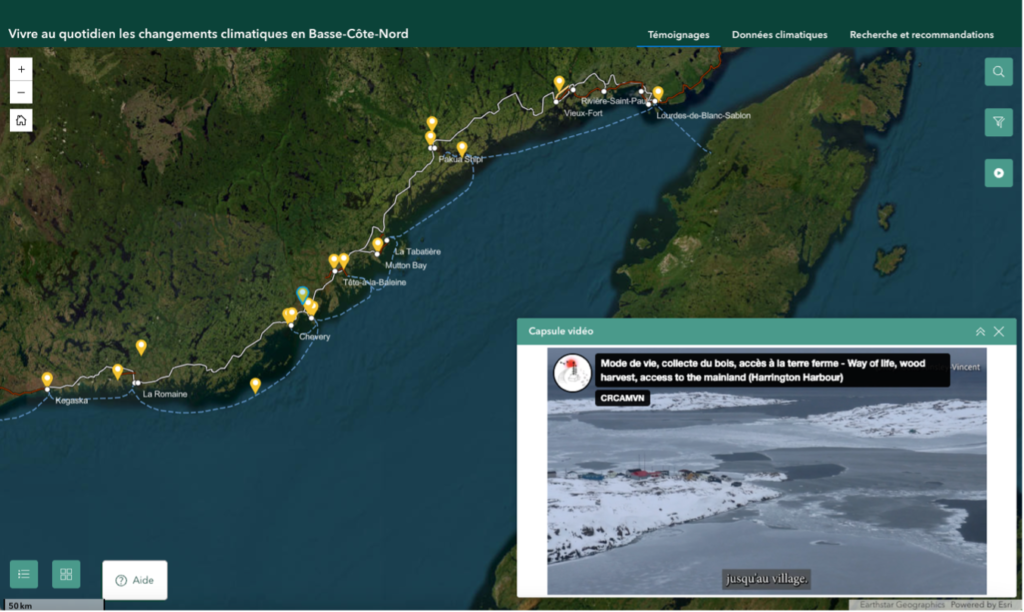
- Narrative Map composed of 20 thematic short videos
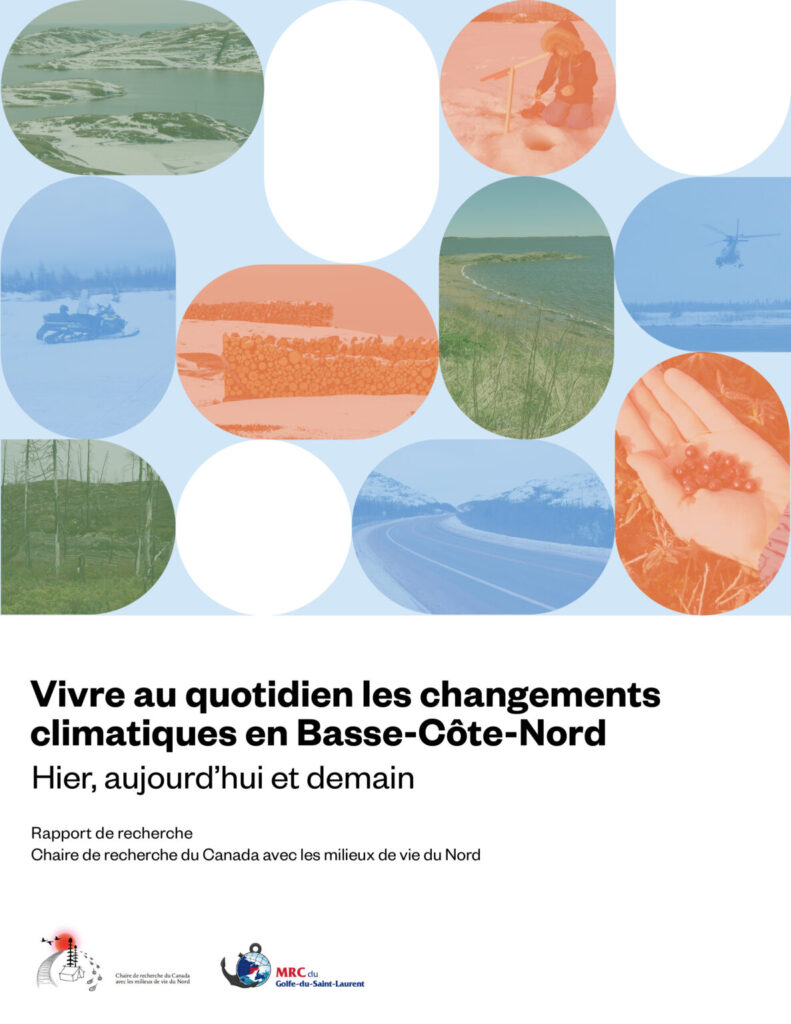
- Research Report (PDF)
The research concludes with a series of recommendations relating to mobility and transportation infrastructure, health and social services, the economy, education, culture, local knowledge and social cohesion, the environment and biodiversity, governance and land-use planning, as well as research, documentation, promotion and awareness.
(Source: Canada Research Chair With Living Milieux of the North)
Narrative Map
Research Report
FAQ
The team gathered the testimony of 217 people, the equivalent of 4.5% of the Lower North Shore population. Data collection relied on 42 individual interviews, 17 group participatory mapping workshops, an online survey, and participant observation. This testimony was then cross-referenced with existing climate data, various government statistics, and regional socio-economic indicators.
It is the first regional portrait of the effects of climate change on the Lower North Shore. The research documents how these transformations hinder mobility, threaten the survival of social and cultural practices, and undermine access to essential services, particularly health care. It also shows that they compound existing socio-economic and demographic difficulties, which deepens the territory’s isolation. Two products came out of it: a report and a narrative map.
The vast majority of survey respondents consider that climate change affects their daily life a lot or extremely. Every mode of transportation and every piece of transportation infrastructure is affected to varying degrees. Air transportation is the most criticized mode, with between 51% and 53% of users reporting dissatisfaction. The unpredictability resulting from these upheavals exacerbates geographic isolation and inequalities in access to essential services.
The portrait drawn by the report and the narrative map gives the MRC a tool for raising awareness among its government and private-sector partners.